LLMs can play a crucial role in decision-making, offering insights into market directions, strategic choices, and an accurate portrayal of the market landscape.
by Thomas Cotter
January 22, 2024
Discovering the power of Large Language Models (LLMs) has become a trend nowadays, with their applications extending across different fields. Although their potential in the financial world is vast, it remains largely untapped. LLMs can play a crucial role in decision-making, offering insights into market directions, strategic choices, and an accurate portrayal of the market landscape.
One key element in understanding the current market is stock news, which serves as a significant indicator. It not only reflects the present market conditions but also provides insights for predicting the future. Overcoming the challenge of accessing stock news is made easier with the Benzinga Stock News API. This data becomes a valuable source of information, especially when utilizing various models and technologies.
This article delves into the exploration of Large Language Models and their application, shedding light on their potential to enhance market analysis.
Installing Libraries
In this part, we’ll look at what we need to make our idea happen. These libraries are important because they help us get the information we need and use the Large Language Model.
OpenAI is a leading artificial intelligence research organization that provides powerful language models, such as GPT-3, for natural language processing and generation.
Benzinga, on the other hand, is a financial news platform that offers the “benzinga” library, enabling users to access and analyze real-time stock market news and data.
Getting the dataset
Now, we’ll use the functions from theBenzingaLibrary to get our dataset. This dataset consists of stock news and comes with various details linked to each piece of news.
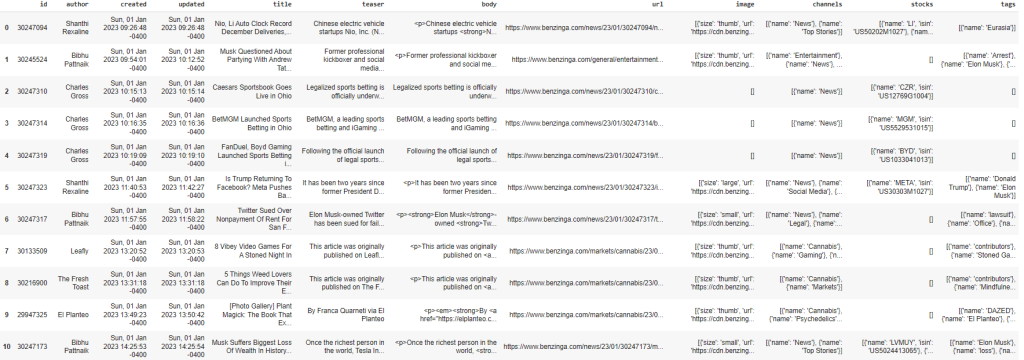
The obtained dataset is characterized by the following attributes:
id: A unique identifier for each entry in the dataset.
author: The author or contributor of the article.
created: The timestamp indicating when the article was originally created.
updated: The timestamp indicating the last update to the article.
title: The title of the article.
teaser: A brief preview or summary of the article content.
body: The main text or body content of the article.
url: The URL link to the full article.
image: Information about the article’s associated image, if available.
channels: Categories or channels to which the article belongs.
stocks: Information about relevant stocks mentioned in the article.
tags: Tags associated with the article, providing additional information or context.
We need to clean the body of the article to remove the HTML tags and special symbols it comes with. The following function uses the regular expressions library to remove all of those.
The dataset has a lot of potential and can be used for various real life applications:
Stock Market Prediction:
Utilize historical data on stocks and associated tags to train machine learning models for predicting future stock market trends.
Financial News Sentiment Analysis:
Analyze the sentiment in article titles and teasers to gauge market sentiment, helping traders and investors make informed decisions.
Influencer Investment Strategies:
Extract information on disclosed investments from influential figures like Bill Ackman to understand and potentially replicate successful investment strategies.
Media Coverage Analysis:
Assess media coverage of companies (e.g., Apple) and personalities (e.g., Alexis Ohanian) for public relations and brand management purposes.
Training Data for NLP Models:
Use the dataset to train natural language processing (NLP) models for various tasks, including sentiment analysis and topic modeling in financial and tech domains.
Prompt and training the model
Next, we’ll define our model. For this instance, I’m opting for gpt-3.5-turbo. Feel free to experiment with different models to find the one that suits your requirements best.
Refining a prompt effectively is crucial to achieve the desired outcomes. Through extensive experimentation, I’ve developed an ideal prompt that combines example-based training with logical reasoning, striving to reduce mistakes and improve precision.
The prompt creation process is delineated into five straightforward phases, applicable to tasks of any complexity. Each phase below will involve experimentation, adjustments, and refinement.
Phase 1:
Firstly, grasp the essence of the task. Document your requirements, starting with the expected response from the prompt. Then, detail the input you’ll provide. Highlight responses that you want the model to avoid. Anticipate potential scenarios the model might generate based on your input and instruct it explicitly to avoid those. This stage naturally involves trial and error.
Phase 2:
Enrich the prompt with context or examples, understanding that more examples can be beneficial but not always necessary. Clarify what the model should extract from these examples and to what extent. Indicate the elements that must be included in the model’s response after processing the context.
Phase 3:
Define the desired response format, preferably mirroring the format used in the provided context. A more structured response format is generally more effective. However, variations might be needed depending on the case, which requires testing different formats.
Phase 4:
Organize the prompt in this sequence: task, context, response format, instructions, and input. This order prioritizes the information’s relevance, decreasing from the beginning to the end. Different tasks might necessitate a different order or additional sections.
Phase 5:
Analyze the responses obtained in each phase to understand the causes of any inaccuracies or ‘hallucinations’ by the model. Guide the model to exclude these inaccuracies by adding a “Note:” at the end of the prompt structure.
Results
Now, we’ll analyze the output for a piece of stock news from our Benzinga dataset. The logical reasoning provided aligns with the sentiment and market direction, suggesting that our model is performing well.
Conclusion
In conclusion, the integration of large language models, exemplified by our use of the Benzinga News Archive and API, opens up immense possibilities in the financial sector. The capabilities these tools offer play a pivotal role in automating processes within the industry. The richness of the data available through Benzinga not only facilitates comprehensive analysis but also paves the way for innovative advancements.
As we navigate this landscape of evolving technology, the synergy between large language models and financial datasets stands as a promising avenue for transforming and optimizing various aspects of the financial realm.
With that being said, you’ve reached the end of the article. Hope you learned something new and useful today, don’t hesitate to reach out if you have any questions!


OTHER ARTICLES

Utilizing the Benzinga News Archive to Power your LLM
The Benzinga News S3 bucket houses an extraordinary source of comprehensive data with the potential to power any Large Language Model (LLM).

Client Spotlight: Yahoo! Finance’s Integration of the Benzinga Analyst Ratings API
Check out how Yahoo! Finance integrated the Benzinga Analyst Ratings API.

Predicting and Analyzing Markets Utilizing a News Archive
LLMs can play a crucial role in decision-making, offering insights into market directions, strategic choices, and an accurate portrayal of the market landscape.
Quick Contact
Address
1 Campus Martius Detroit,
MI 48226, United States
Phone
Get in Touch